About Us
One writer covers this site, every page carries her name and three dates, and the numbers in the tables come from opening the cashier rather than from copying another guide. This page explains the process so you can judge how much weight to put on any of it.
The Author

Katie Evans
Payments and Banking Editor
Auckland, New Zealand
Katie has covered online gambling payments for eight years, first for a Wellington fintech newsletter and since 2021 for this site. She tests deposits and withdrawals with her own money and keeps the receipts.
Her focus is the unglamorous end of online gambling: cashiers, payout timelines, verification, and the gap between what a promotion advertises and what its terms say. She writes every page on this site, which is a deliberate choice — one person covering one brand means the figures on the payments, withdrawal times and minimum deposit pages are checked against each other rather than drifting apart.
Eight years on payments
Started on a Wellington fintech newsletter, moved to gambling payments in 2021. The overlap is larger than it sounds.
Own money, real accounts
Deposits and withdrawals are made and timed personally. Numbers that could not be verified are labelled as reported, not stated as fact.
One author per site
No rotating bylines and no house voice. If a page is wrong, there is one person it belongs to.
What the Three Dates Mean
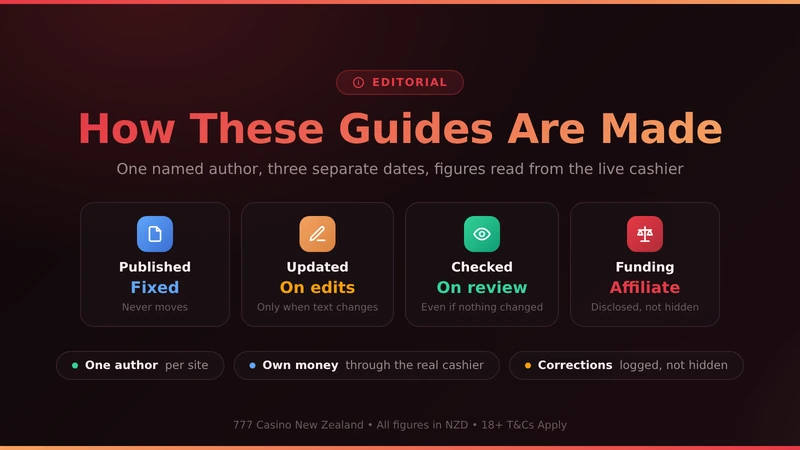
Every page here carries three dates in a thin line at the foot of the page. They are deliberately different things, and a single "last updated" stamp — the industry norm — hides the distinction that actually matters.
Published
When the page first went live. It never changes. It tells you how long the page has existed, which is context a single date destroys.
Updated
When the content last actually changed — a limit moved, a method was added, a section rewritten. Fixing a typo does not move it. If nothing changed, this date stays where it is.
Checked
When the facts were last verified against the live cashier, whether or not anything needed changing. A recent Checked date with an older Updated date is the healthy case: we looked, and it was still right.
Why this matters: a page that quietly bumps its "updated" stamp every week tells you nothing about whether anyone read it. Splitting verification from revision means the dates carry information instead of decoration.
How a Page Gets Written and Checked
-
1
Open the cashier and read it
Limits, fees and processing times come from the live cashier and the terms attached to them, not from another guide. Where a figure cannot be confirmed, it is described as reported rather than stated flatly.
-
2
Move real money through it
Payout timings come from requests that were actually made and timed. This is why the withdrawal page separates the pending review from the payment rail — because those two waits feel identical and are not.
-
3
Read the terms, not the banner
Wagering multipliers, game contribution percentages and qualifying deposits are taken from the terms document. The headline number on a promotional banner is marketing, and it is usually the least informative figure on the page.
-
4
Check the regulator, not the badge
A licence claim is verified against the issuing register. The sister sites page carries a tool that points at those registers so you can repeat the check yourself.
-
5
Re-check on a schedule and stamp it
Pages are revisited whether or not anything looks wrong, and the Checked date moves even when nothing else does. Where figures changed, the change is recorded in a was/is-now table rather than silently overwritten.
How This Site Is Funded
This site carries affiliate links. If you follow one and open an account, the site may be paid a commission. That is the business model and pretending otherwise would be silly, so it is stated here rather than buried in a footer.
What the commission does not buy is the content of the tables. A payout that takes three days is written as three days. Paysafecard cannot receive withdrawals, so the pages say so repeatedly, even though it is an inconvenient fact. The minimum deposit page argues that taking no bonus at all is often the better choice on a small deposit, which is not what an affiliate incentive would produce.
The reasoning is straightforward. A guide that gets the cashier wrong is worthless to the reader on their first withdrawal, and a reader who was misled does not come back. Accuracy is the only durable version of this.
Corrections and Changes
Casino terms change without notice and sometimes without any announcement at all. When a figure on this site turns out to be out of date, it is corrected and the change is recorded in the was/is-now table on the relevant page rather than quietly overwritten — a reader who remembers the old number deserves to know it changed rather than to doubt their own memory.
The status page works the same way. Its outage log is cumulative, so entries are added and never removed. A log that only shows the present tells you nothing about how often something happens.
Responsible Gambling in New Zealand
Everything on this site assumes gambling is entertainment you have chosen and can stop. If that has stopped being true, free and confidential help is available in New Zealand around the clock, and using it is not a big dramatic step — most people who call are simply asking a question.
Practical tools help too. Deposit limits take effect immediately and take a cooling-off period to raise, which is the point of them. Reality checks interrupt a long session. Time-outs pause an account for a set period, and self-exclusion closes it across an operator's whole group of brands.
Gambling Helpline New Zealand
Free, confidential, 24/7 on 0800 654 655. Also supports family and whānau, not only the person gambling.
Ministry of Health
Funds free problem gambling services nationwide, including face-to-face counselling.
18+ only. Gambling should never be treated as a way to make money or to solve a financial problem. Set a limit before you deposit, not after.